> For the complete documentation index, see [llms.txt](https://help.swarmia.com/llms.txt). Markdown versions of documentation pages are available by appending `.md` to page URLs; this page is available as [Markdown](https://help.swarmia.com/definitions/developer-effort-ftes/daily-effort-model.md).
# What changed in the effort model in August 2026
Developer effort is now calculated daily instead of monthly.
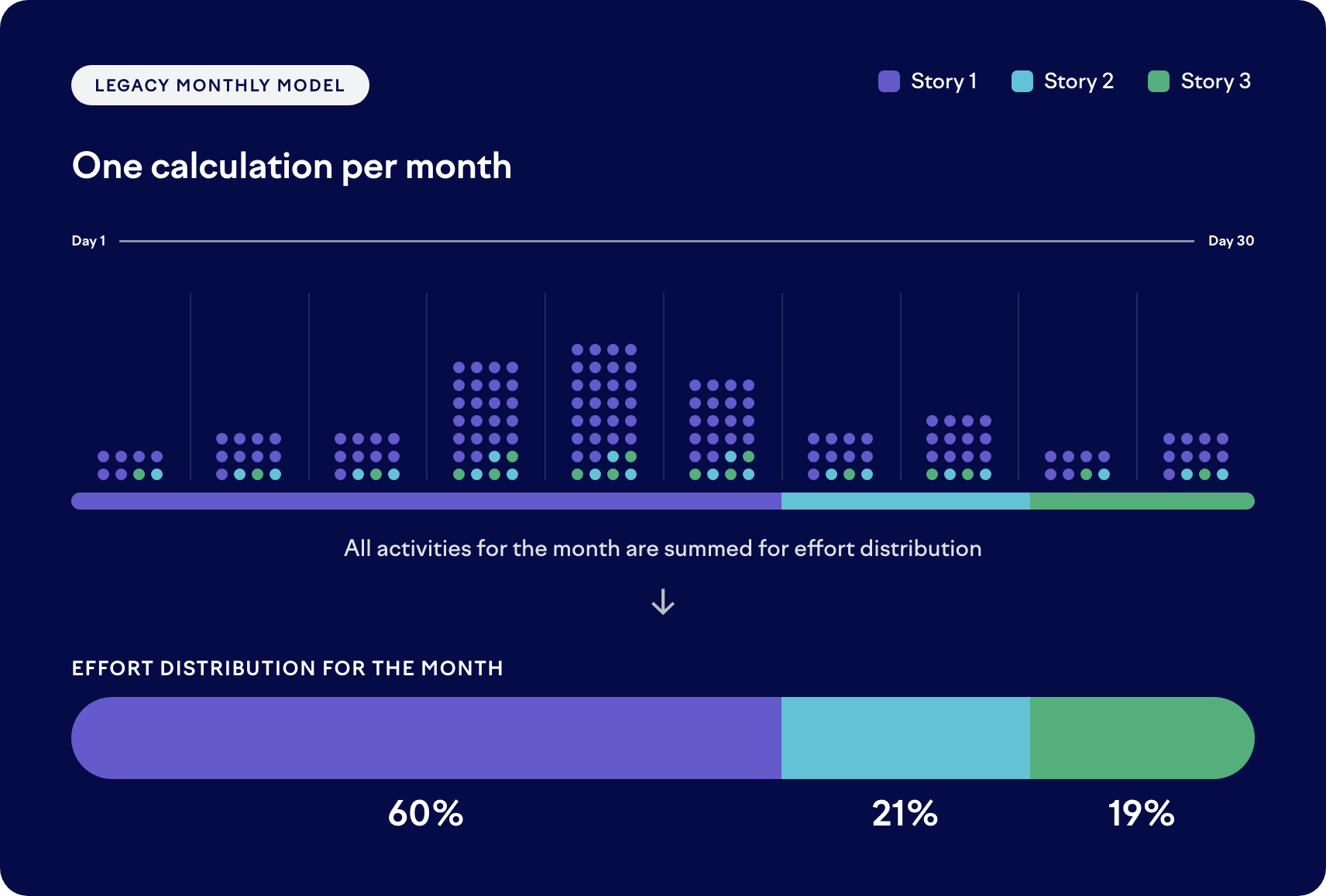
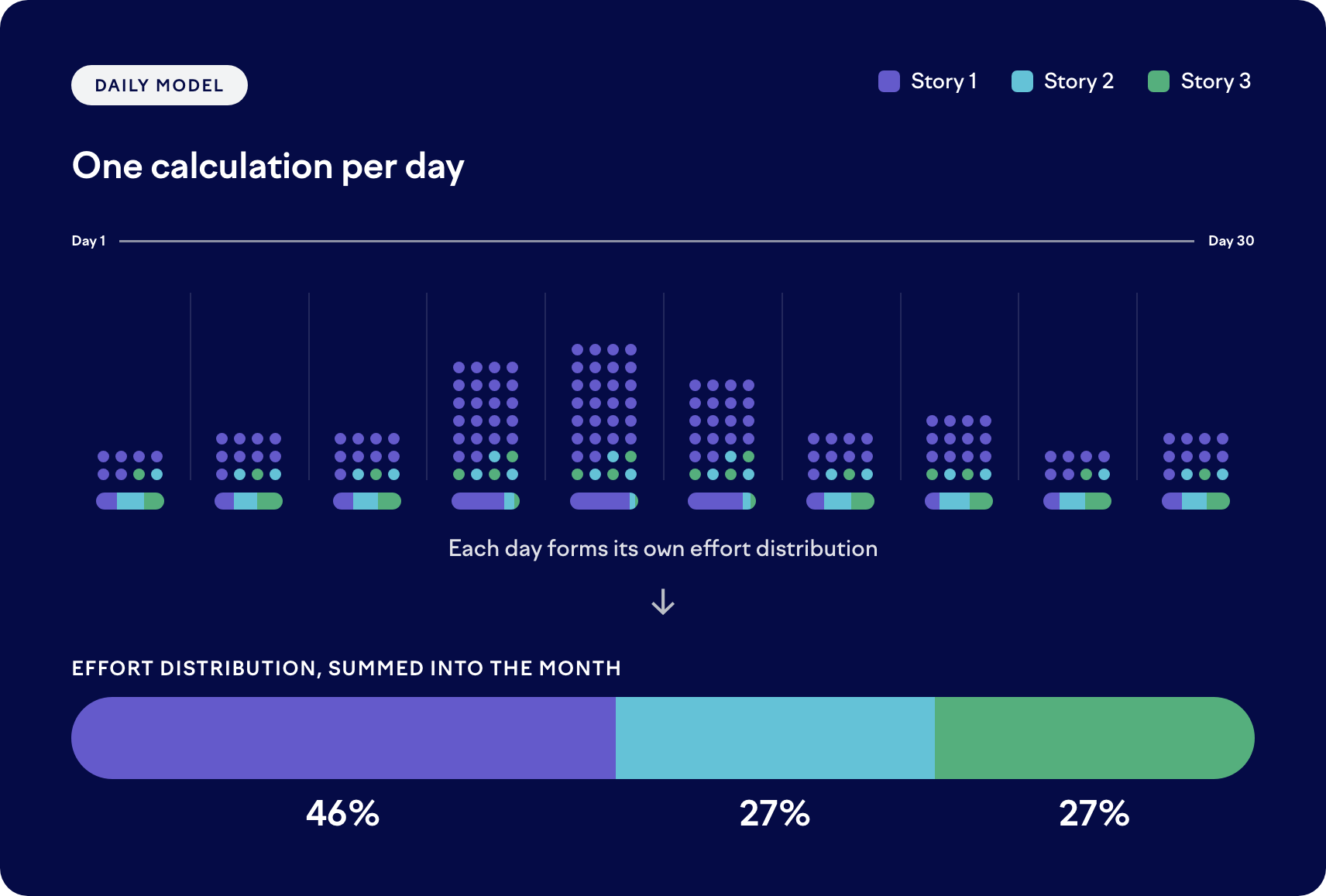
Since late August 2026, developer effort is calculated one working day at a time instead of once for the whole month. This gives you a more accurate view of how effort is spread across the month.
We’ve also recalculated historical data using the new model, so you may see small changes in past figures.
### Key changes in the new model
{% columns %}
{% column %}
Legacy monthly model
{% endcolumn %}
{% column %}
Daily model
{% endcolumn %}
{% endcolumns %}
* Each working day is calculated separately, then added up for the month.
* **Intermittent work is reflected more accurately.** Someone active on 5 of 22 working days will land around 0.2 FTE rather than close to 1.0.
* **Days without activity reduce effort.** This better reflects irregular work patterns. For part-time engineers, reduced FTE allocations may need to be reviewed so effort isn’t reduced twice.
* **Issue-tracker work counts more.** Assigned in-progress issues carry more weight, making the model more accurate for authors with little or no coding activity.
* **Pull requests not linked to an issue now count fully.** Previously, they were given half weight.
* **Human activity on bot-authored pull requests now counts.** Previously, reviews, comments, and other human activity on these pull requests were excluded.
## How the daily model compares to the legacy model
| | Legacy effort model | Daily effort model |
| -------------------------------------------------- | ---------------------------------------------------------- | --------------------------------------------------- |
| How effort is calculated | From a whole month's activity in one calculation | Each working day separately, then added together |
| Granularity of the calculation | One value per month | One value per working day |
| Working days without activity | Only stretches longer than 5 business days are deducted | Every working day without activity lowers effort |
| Minimum activity | Authors with fewer than 10 activities a month are excluded | No minimum, even a single event counts |
| Authors with only issue-tracker activity (no code) | Excluded, below the minimum | Receive effort from their assigned in-progress days |
| Activity on pull requests not linked to an issue | Counted at half weight | Counted at full weight |
| Assigned in-progress issues | Counted | Counted, with more weight |
| Human activity on bot-authored pull requests | Excluded | Counted |
| Weekend activity | Added to the month's total | Doesn't add to the month's total |
## Everything else stays the same
* We still use commits, pull requests, reviews, comments, and assigned in-progress issues as inputs to the model.
* Bots are still excluded.
* You can still allocate fractional FTEs for part-time employees.
* Time offs still lower effort total (you can manage time offs in Swarmia using your [HR system](/settings/integrations/hr-systems.md), a [CSV upload](/settings/integrations/hr-systems/upload-time-off-data-via-csv.md), or the [Time offs API](/settings/integrations/swarmia-apis/time-off-api.md))
* An author can still reach at most 1.0 FTE in a month.
We keep refining the effort model based on the data we gather and real usage, making it more accurate and easier to understand.
---
# Agent Instructions
This documentation is published with GitBook. GitBook is the documentation platform designed so that both humans and AI agents can read, navigate, and reason over technical content effectively. Learn more at gitbook.com.
## Querying This Documentation
If you need additional information that is not directly available in this page, you can query the documentation by asking a question.
Perform an HTTP GET request on the following URL with the `ask` and `goal` query parameters:
```
GET https://help.swarmia.com/definitions/developer-effort-ftes/daily-effort-model.md?ask=&goal=
```
`ask` is the immediate question: it should be specific, self-contained, and written in natural language.
`goal` is what the user is ultimately trying to achieve, the reason they need the answer. Sharing it helps GitBook give you a better, more relevant answer. A goal is most helpful when it describes the outcome the user wants rather than restating the question. For example, with `ask=how do I create an API token`, a goal like `automate deployments from our CI pipeline` lets GitBook tailor the answer to that use case.
The response will contain a direct answer to the question and relevant excerpts and sources from the documentation.
Use this mechanism when the answer is not explicitly present in the current page, you need clarification or additional context, or you want to retrieve related documentation sections.