> For the complete documentation index, see [llms.txt](https://help.swarmia.com/llms.txt). Markdown versions of documentation pages are available by appending `.md` to page URLs; this page is available as [Markdown](https://help.swarmia.com/definitions/batch-size.md).
# Batch size
Batch size measures how much work is bundled up in a change. Swarmia offers tools for evaluating pull request batch size by looking at the total number of changes in a single pull request.
## Definition
Batch size is calculated by the lines of code changed (lines added + lines removed) in a given pull request.
### Excluding auto-generated files
Repositories often contain generated files, which could be related to e.g. package dependencies. In order to provide an accurate view of the real changes, Swarmia automatically cleans up the total change count of some commonly used generated files.
You can configure these exclusions in [Settings > Pull requests > File exclusions](https://app.swarmia.com/settings/pull-requests/file-exclusions). Swarmia provides an extensive set of default rules to filter out most common generated files.
## Example
A pull request with 541 lines added and 215 lines removed (**+541** **-215**) has a batch size of **756**.
## Why it matters
Splitting work into small increments is a great way to improve delivery. Small pull requests are easier to plan and review, and less risky to deploy.
Read more in [Analyzing pull request batch size](/guides/improve-pull-request-flow/analyzing-pull-request-batch-size.md)
## Batch size benchmarks
* **Great:** < 200 lines
* **Good:** < 500 lines
* **Needs attention:** ≥ 500 lines
## How to use it
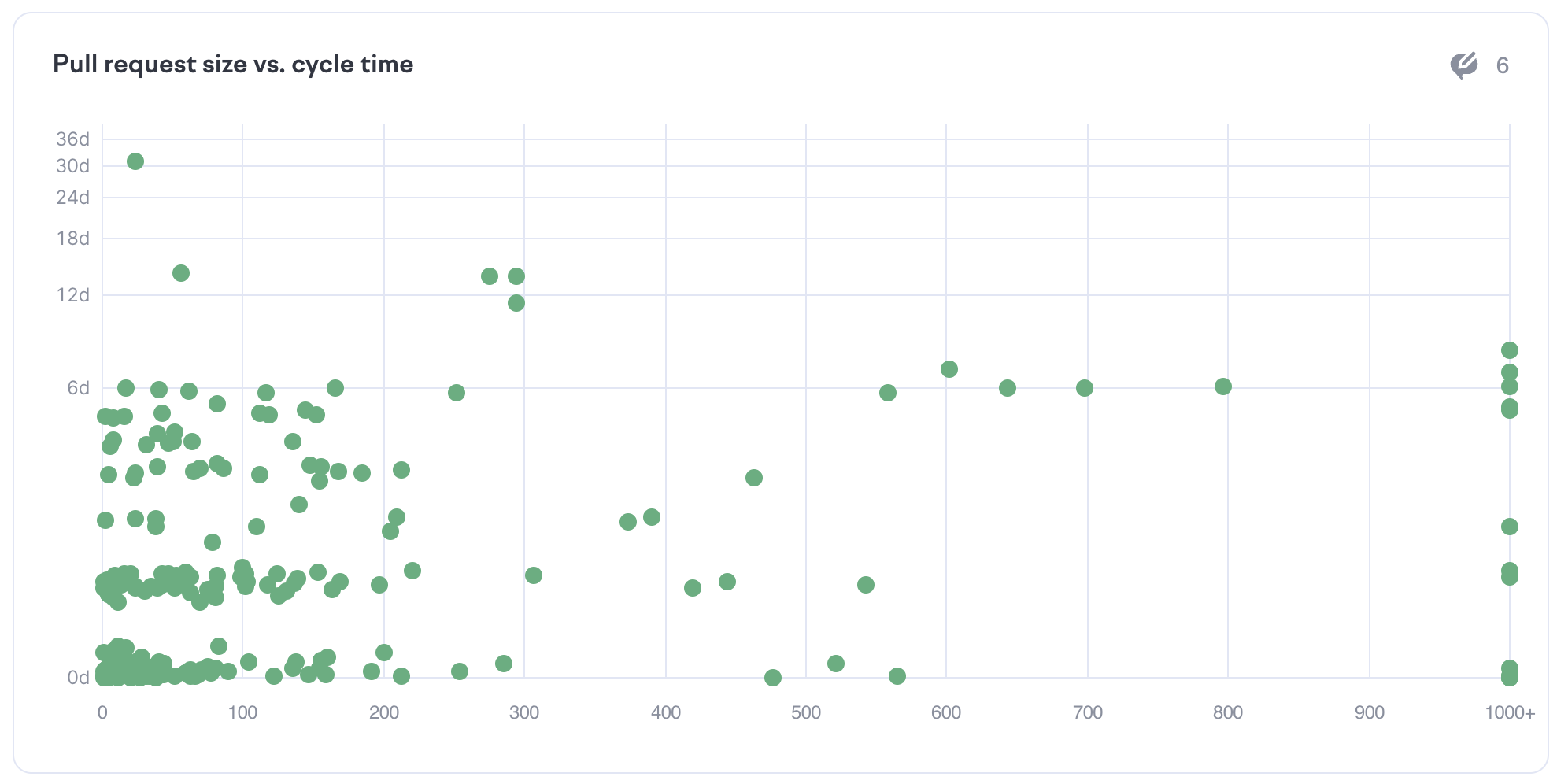
In Swarmia, the chart that shows the pull request size vs cycle time shows a set of pull requests in the selected time frame and charts them based on their individual cycle time and the total number of lines of code changed in the pull request. This chart allows you to see correlations between the size of a pull request and its cycle time.
Pull request size vs. cycle time plot in Swarmia
Seeing the distribution of larger batch sizes and higher cycle times can indicate that your team needs to focus on delivering smaller batch sizes. This change can improve not only your cycle time but also your quality.
See also [Analyzing pull request batch size](/guides/improve-pull-request-flow/analyzing-pull-request-batch-size.md)
## Where to find it
You can find batch size metrics under [Insights → Code → Batch size](https://app.swarmia.com/insights/code/batch-size).
---
# Agent Instructions
This documentation is published with GitBook. GitBook is the documentation platform designed so that both humans and AI agents can read, navigate, and reason over technical content effectively. Learn more at gitbook.com.
## Querying This Documentation
If you need additional information that is not directly available in this page, you can query the documentation by asking a question.
Perform an HTTP GET request on the following URL with the `ask` and `goal` query parameters:
```
GET https://help.swarmia.com/definitions/batch-size.md?ask=&goal=
```
`ask` is the immediate question: it should be specific, self-contained, and written in natural language.
`goal` is what the user is ultimately trying to achieve, the reason they need the answer. Sharing it helps GitBook give you a better, more relevant answer. A goal is most helpful when it describes the outcome the user wants rather than restating the question. For example, with `ask=how do I create an API token`, a goal like `automate deployments from our CI pipeline` lets GitBook tailor the answer to that use case.
The response will contain a direct answer to the question and relevant excerpts and sources from the documentation.
Use this mechanism when the answer is not explicitly present in the current page, you need clarification or additional context, or you want to retrieve related documentation sections.